
How AI turns bank statements into credit underwriting signals
How raw bank transactions become income patterns, financial indicators, and risk signals for credit teams.
A bank statement can run into hundreds of transactions. For an underwriter, the job is not to read every debit and credit. It is to understand what those transactions say about the borrower.
- Is income regular?
- How much is already committed to EMIs?
- Does the account maintain enough balance through the month?
- Are payments getting returned?
- Is there a sudden credit that does not fit the usual pattern?
Finding those answers manually takes time, especially when a lender is processing statements from different banks, account types, and borrowers. Automated bank statement analysis helps by doing much of the transaction-level work before the file reaches the underwriter. But getting from a PDF to an underwriting insight involves more than extracting a table.
The statement has to be read correctly
Bank statements do not follow one standard layout. A digital PDF from one bank may have separate debit and credit columns, while another may present transactions differently. Scanned statements add another layer of difficulty because document quality can vary.
The first task is to capture the basic transaction data correctly:
- Transaction date
- Narration
- Debit and credit amounts
- Running balance
- Account information
At this point, the system has data, but not much intelligence.
Suppose a ₹50,000 credit appears in the account. Knowing the amount is useful, but an underwriter still needs to know what it represents. It could be salary, business income, a transfer from another account, or a one-time credit. That is why extraction alone is not enough for bank statement analysis.
Making sense of transaction narrations
Bank narrations were never designed to make life easy for an analyst. A statement may contain entries such as:
SALARY SEP
ACH EMI
UPI/XXXX/ABC
NEFT XYZ ENTERPRISES
There may be abbreviations, payment references, account identifiers, merchant names, and transaction channels packed into a single line.
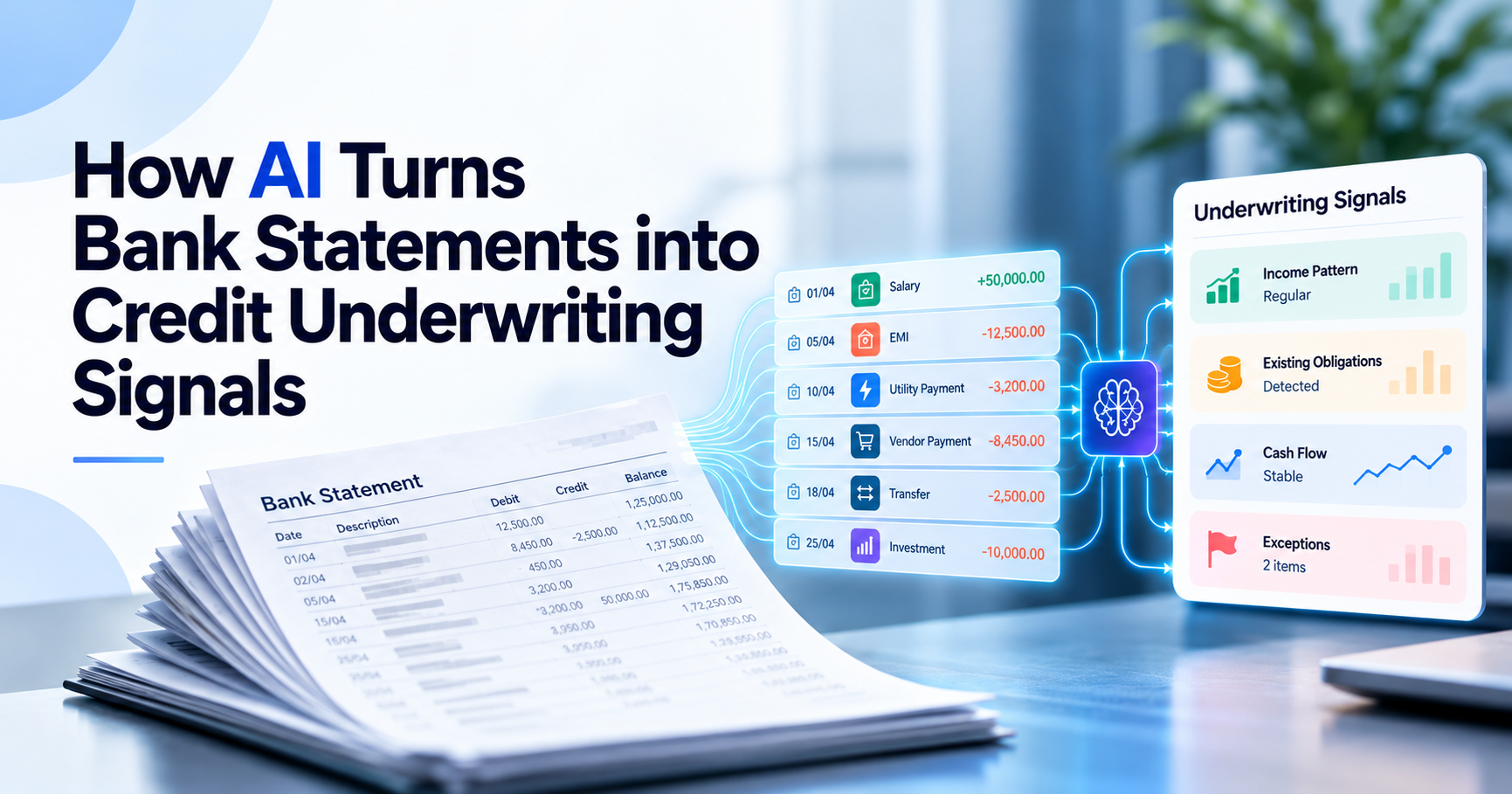
Transaction categorisation gives these entries meaning. Salary credits can be separated from transfers. EMIs can be identified as existing obligations. Vendor payments, cash withdrawals, utility payments, investments, and other expenses can be grouped accordingly.
This is a critical part of the process because underwriting depends on the nature of a transaction, not just its value. A ₹50,000 salary credit and a ₹50,000 transfer into the account may look identical in the credit column. They do not tell the same financial story.
One transaction matters less than the pattern
Once transactions are categorised, the statement can be analysed over time. Take salary as an example. One salary credit confirms very little about income stability. When similar credits appear regularly across the statement period, the pattern becomes more useful.
EMIs work the same way. Recurring loan repayments show how much of the borrower's income is already committed before another loan is considered. The account balance adds further context. Frequent low balances, returned payments, irregular credits, or sharp changes in cash flow may deserve a closer look.
Instead of making an analyst find each of these patterns manually, automated analysis can bring them together for review.
Turning transactions into underwriting metrics
Credit teams rarely need another transaction dump. They need information they can use while assessing the application. Depending on the lending workflow, bank statement analysis can help surface:
- Income and credit patterns
- Average balances
- Existing EMI obligations
- Cash-flow consistency
- Returned or bounced transactions
- High-value transactions
- Recurring financial commitments
- Unusual account activity
These indicators make a long statement easier to review, but they should remain connected to the underlying transactions. If an income figure looks unusual, the analyst should be able to see which credits contributed to it. If an exception is flagged, the relevant transaction should be available for review. That traceability matters when financial data is being used to support a lending decision.
What happens to the exceptions?
Automation is useful because most transactions do not need the same level of attention. A regular salary credit that matches the established pattern is different from an unexplained high-value deposit. A recurring EMI is different from a debit that appears once with an unusual narration.
The system can surface transactions or patterns that fall outside what it expects. The analyst can then examine those cases in context. An unusual transaction is not automatically fraud, and it does not automatically make a borrower risky. It is simply something that may need investigation.
This is where the division of work between AI and the credit team becomes practical. Software can process large transaction volumes and surface what needs attention. The underwriter decides what that information means for the application.
From a bank statement to a credit decision
Think about what has happened by the time the statement reaches this point. The document has been read. Transactions have been extracted and organised. Narrations have been interpreted. Similar financial activity has been grouped. Patterns have been identified. Relevant calculations have been made. Exceptions have been surfaced.
The underwriter is no longer starting with pages of raw transactions. They are starting with an organised view of the borrower's account activity, with the underlying transactions available when they need to investigate further.
That is a much more useful role for AI across banking and financial services, where the technology can support credit underwriting without trying to make the lending decision itself.
How DocuGenie.AI™ fits
DocuGenie.AI™ Bank Statement Analyzer is built to automate this transaction-heavy part of the lending workflow. It processes bank statements, extracts transaction-level data, categorises financial activity, and helps identify patterns and exceptions that credit teams need to review.
For the underwriter, the benefit is straightforward. Less time goes into reading statements line by line and preparing the data for analysis. More time can go into reviewing the borrower, investigating exceptions, and applying credit policy.
Wrap up
Bank statement analysis is not difficult because lenders lack the data. The data is already sitting in the statement. The difficult part is making sense of it consistently when every application can bring hundreds of transactions and different statement formats.
A bank statement analyzer takes care of much of that groundwork. It turns the statement into organised financial information while keeping the credit decision where it belongs: with the underwriter.